


A Symbol of Defiance and Resilience
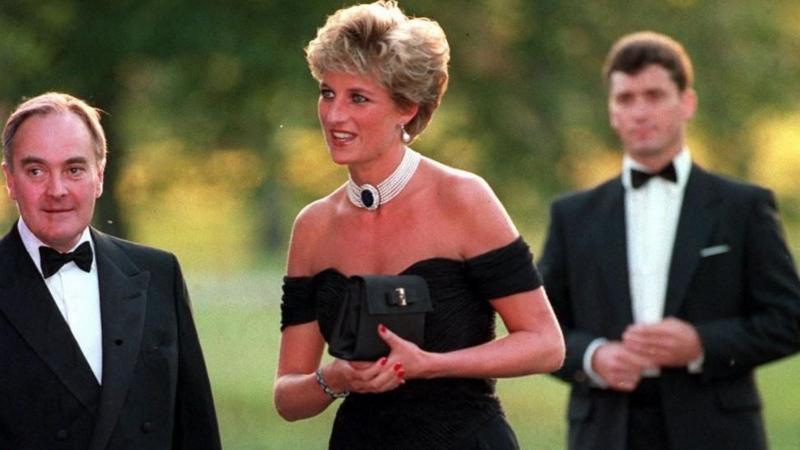
One of the most iconic garments in modern royal history is set to capture headlines once again as Sotheby’s prepares to auction Princess Diana’s 1994 ‘revenge dress’ on December 9th. The midnight-black silk ensemble, designed by Greek couturier Christina Stambolian, was worn by Diana during a pivotal moment in her life—the same evening her estranged husband, the then-Prince Charles, publicly admitted to adultery in a televised BBC interview. Rather than retreating in private grief, Diana chose to make a bold public statement, attending a Vanity Fair gala at London’s Serpentine Gallery in a dress that strategically revealed her shoulders and legs, symbolizing both vulnerability and strength. The image of Diana arriving at the event in the dramatic gown became an enduring emblem of her refusal to be overshadowed by scandal.
The dress’s transformation from a personal wardrobe choice to a cultural artifact occurred almost instantly. By the next morning, British tabloids had crowned it the ‘revenge dress,’ a label that stuck due to its perceived role as Diana’s sartorial response to Charles’s confession. Anna Harvey, Diana’s longtime stylist, revealed that the princess had initially planned to wear a more traditional Valentino gown but changed her mind at the last minute, opting instead for Stambolian’s design. Diana reportedly felt the dress was ‘too sensual’ for previous occasions but deemed it perfect for the charity gala, where she paired it with a royal-family heirloom brooch, a black clutch, and stiletto heels. Morgane Halimi, Sotheby’s global head of handbags and fashion, emphasized that Diana ‘understood instinctively that fashion can be a language in itself,’ using the dress to reclaim control over her narrative during a deeply scrutinized period of her life.
Legacy and Auction Prospects
The upcoming auction marks the first time the ‘revenge dress’ will be offered for sale since 1997, when Diana herself sold 79 of her most memorable outfits to raise funds for charitable causes. At the time, she donated the proceeds to organizations supporting landmine victims and children’s welfare, reflecting her commitment to humanitarian work even amid personal turmoil. Sotheby’s estimates the dress could fetch up to $300,000, a figure that underscores its status as a rare and historically significant piece. This valuation aligns with recent sales of Diana’s memorabilia, including a 2023 auction of her famous sheep-print sweater—worn during a 1983 tour of Australia—which sold for $1.24 million, and the sale of her 1988 Jaguar XJ40 earlier this year for $90,000.
The dress’s enduring appeal lies not only in its association with a defining moment in British history but also in its embodiment of Diana’s nuanced relationship with the media and public adoration. While Charles’s interview was intended to address rumors and preserve the monarchy’s image, Diana’s appearance at the gala shifted the narrative entirely, transforming her from a discarded royal into a symbol of resilience. The design itself, with its asymmetrical neckline and figure-hugging silhouette, defied the conservative expectations of royal dress, reinforcing her reputation as a trendsetter unafraid to challenge norms. Christina Stambolian, the designer behind the gown, later recalled that Diana had purchased the dress three years prior but had never worn it, deeming it ‘too daring’ for her public persona at the time. Its selection for the 1994 event marked a deliberate pivot, one that resonated globally and continues to influence fashion discourse decades later.
As the auction date approaches, the ‘revenge dress’ will once again step into the spotlight, not as a relic of heartbreak but as a testament to Diana’s ability to transform personal adversity into a legacy of empowerment. For collectors and historians alike, the garment represents a rare convergence of fashion, politics, and cultural memory—a moment when a single outfit became a mirror for society’s hopes, fears, and fascination with the British royal family.









Deja una respuesta